
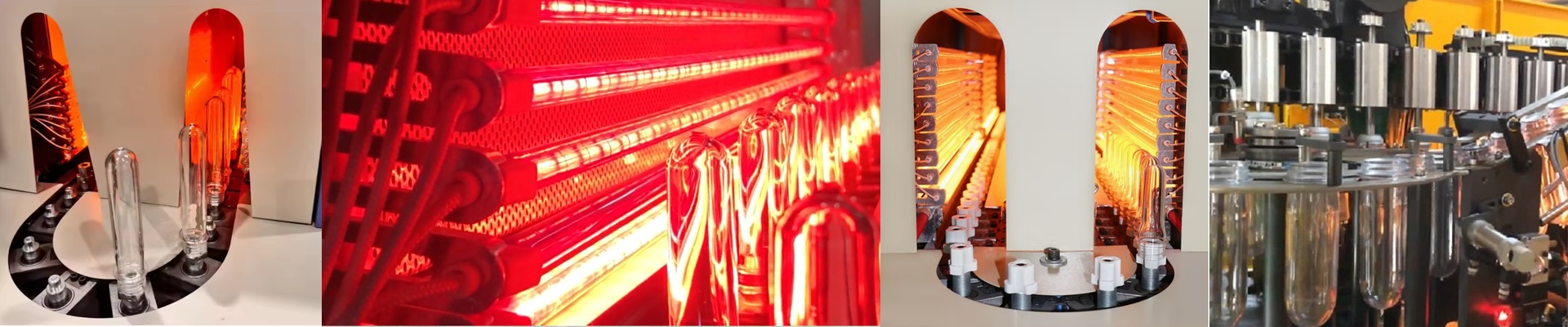
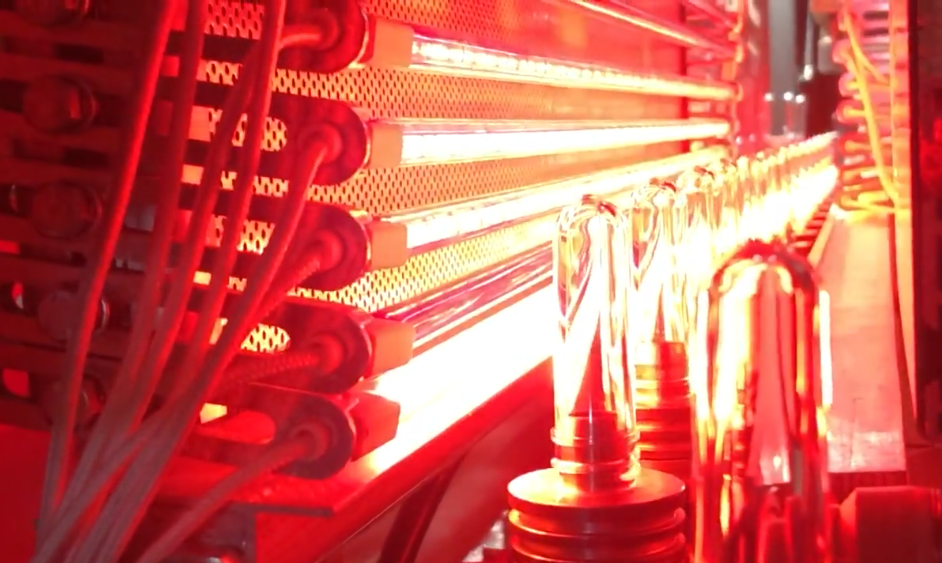
On a high-speed blow molding line, the heating stage is where you earn your keep—where clarity is won and uptime is decided. If preform temperature drifts, you’ll see haze, crystallization, and wall thickness that’s all over the map. And when the heating tunnel can’t keep pace with the stretch blow molding cycle, the whole line starts to drag. What matters, technically We design the heating around controlled infrared energy—tuned to how PET absorbs heat, and aimed at clean preform penetration. The goal is a repeatable temperature rise and a stable thermal profile along the neck and body. Power matching is set to your blow molder’s heating tunnel length and throughput, so emitter output lines up with the dwell time you need. Quartz emitters give you fast response and tight thermal control, and the reflector geometry shapes the heat flux to keep the hot zone even. We match common mounting and connections, including R7s, so the retrofit drops in without rewiring or panel changes. Here’s what that looks like on the floor. You can run at the machine’s rated cycle with less temperature swing, which cuts stress marks and improves bottle clarity. Preforms heat faster, so the stretch ratio holds steady across the cavity, and wall thickness distribution tightens up. Energy use drops because the emitters cycle quickly, with minimal idle losses. On Sidel, Krones, SIPA, Husky, SACMI, and Nissei ASB machines, the same focus—power matched to the job and thermal field kept under control—keeps the heating section stable, even when ambient conditions shift. A few realities to keep in mind. Infrared heating is sensitive to geometry and spacing. Keep emitter-to-preform distance consistent, and keep reflectors clean so the designed heat flux stays intact. When you change bottle formats, you’ll often need to retune the power map to keep the temperature curve inside the preform’s sweet spot. Plan the installation around access—cooling, clean air, and proper insulation prevent hot spots and protect the quartz.